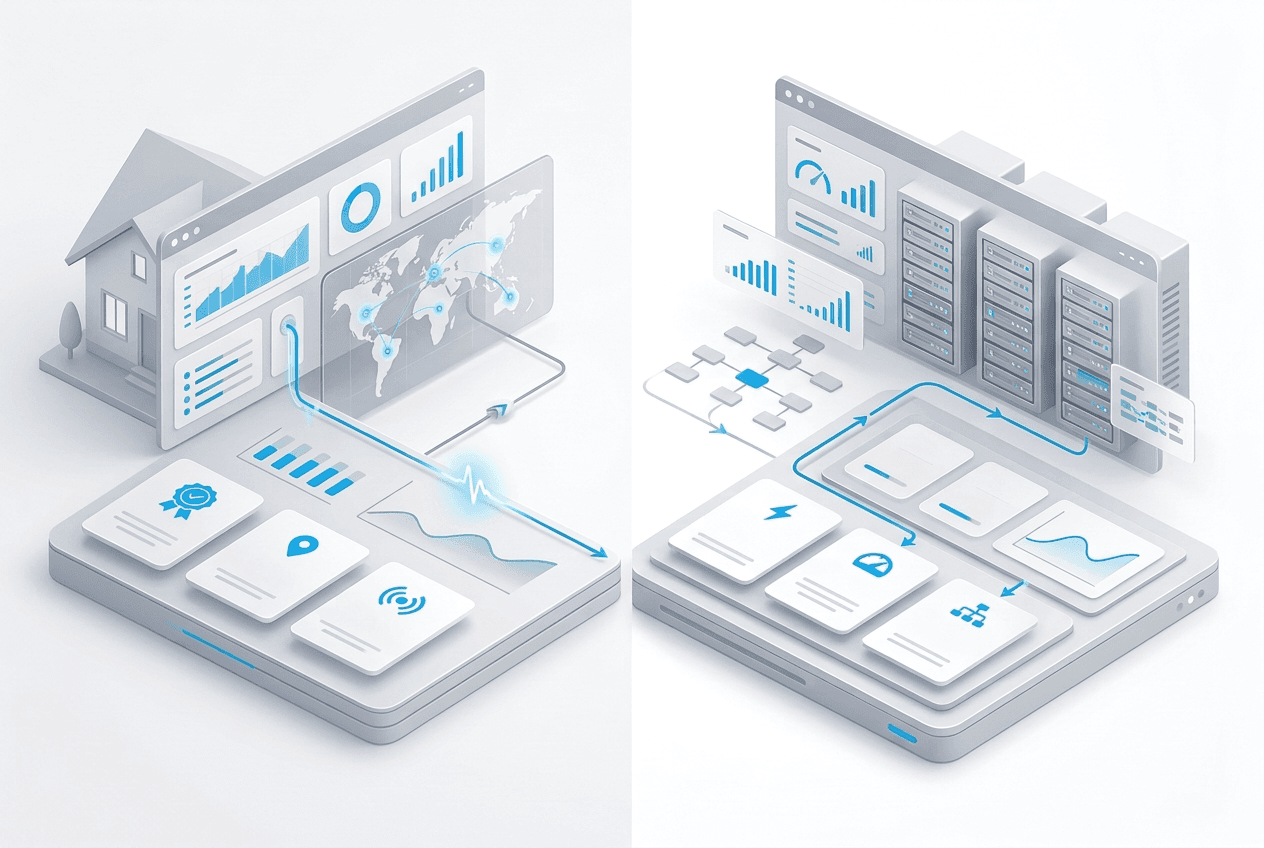
Datacenter vs residential proxies: which should you use?
Datacenter proxies are hosted on servers in data centers — they're fast and cheap but easy for websites to detect and block. Residential proxies use IP addresses from real ISP-connected households — slower and pricier but nearly undetectable. Choose based on your target site's anti-bot defenses.
What are datacenter proxies?
Datacenter proxies route your traffic through IP addresses assigned to servers in commercial data centers. These IPs are not associated with any ISP or residential internet connection — they belong to hosting companies, cloud providers, and colocation facilities.
Because they're hosted on high-performance servers with enterprise-grade bandwidth, datacenter proxies deliver the fastest response times and lowest latency of any proxy type. They're also the cheapest to operate at scale, making them attractive for high-volume tasks where speed matters more than stealth.
The trade-off: datacenter IP ranges are publicly cataloged. Websites can identify traffic from known datacenter ASNs and block or challenge it instantly. Anti-bot systems like Cloudflare, Akamai, and DataDome maintain real-time databases of datacenter IP ranges and treat all traffic from them with heightened scrutiny.
TrueProxies offers Datacenter IPv6 proxies from $59.50/month with unlimited bandwidth across 27+ global regions.
What are residential proxies?
Residential proxies route your traffic through IP addresses assigned by real Internet Service Providers to real households. These IPs belong to ISPs like Comcast, AT&T, BT, and Deutsche Telekom — the same addresses regular people use to browse the internet from home.
To any website you visit, your request looks identical to a regular person browsing on their home connection. There's no datacenter ASN to flag, no known proxy range to block. Anti-bot systems have no reliable signal to distinguish your proxy traffic from genuine visitors.
This makes residential proxies essential for accessing sites with strong anti-bot protection — e-commerce platforms, social media, search engines, and any site that aggressively blocks automated traffic.
TrueProxies offers 50M+ residential IPv4 proxies across 150+ countries, with pay-per-GB from $1.64/GB or unlimited bandwidth from $3.26/hour.
Datacenter vs residential proxies — side-by-side comparison
| Feature | Datacenter proxies | Residential proxies |
|---|---|---|
| IP source | Data center servers | Real ISP-connected households |
| Speed | Very fast (sub-100ms) | Good (200-800ms typical) |
| Detection risk | High — IPs are cataloged | Very low — appear as real users |
| Cost | Cheapest | More expensive |
| Best for | Unprotected sites, speed-critical tasks | Protected sites, anti-bot bypass |
| Anti-bot bypass | Weak | Strong |
| Geo-targeting | Region-level | Country/City/ZIP/ASN |
| Session types | Static or rotating | Sticky or rotating |
| IP pool size | Large but identifiable | Large and undetectable |
When to use datacenter proxies
Scraping sites without anti-bot protection. Many websites don't implement sophisticated bot detection. For these targets, datacenter proxies deliver faster results at lower cost. Blogs, news sites, government databases, and smaller e-commerce sites often fall into this category.
Speed-critical operations. When latency matters more than stealth — load testing, performance monitoring, or accessing APIs that don't restrict by IP type — datacenter proxies' sub-100ms response times are hard to beat.
High-volume, low-sensitivity scraping. If you're scraping millions of pages from sites that don't actively block datacenter traffic, the cost savings add up significantly. Datacenter proxies can be 5–10x cheaper per request than residential alternatives.
IPv6-specific tasks. Many newer services and platforms support IPv6 natively. TrueProxies' Datacenter IPv6 proxies offer billions of fresh addresses from 27+ global regions with unlimited bandwidth from $59.50/month.
When to use residential proxies
Scraping protected e-commerce sites. Amazon, Walmart, Nike, and most major retailers use multi-layered anti-bot systems. Datacenter proxies get blocked within minutes. Residential IPs pass these defenses because they match the profile of legitimate shoppers.
Social media management. Instagram, Facebook, TikTok, and LinkedIn actively detect and ban accounts operating from datacenter IPs. Residential proxies with sticky sessions provide the consistent, trusted IP identity each account needs.
SEO monitoring and SERP tracking. Search engines serve different results to datacenter IPs and sometimes block them entirely. Residential proxies ensure you see the same search results your audience sees.
Ad verification. Publishers can detect datacenter verification tools and serve compliant ads only to those IPs while showing different content to real users. Residential proxies prevent this cloaking behavior.
Any site with Cloudflare, Akamai, or DataDome. If your target site uses enterprise anti-bot protection, residential proxies aren't optional — they're required.
Can you use both together?
Yes, and many teams do. The optimal approach is to test your target site with datacenter proxies first. If they work, you save money. If they get blocked, switch to residential proxies for that specific target.
A common setup: use datacenter proxies for bulk crawling of unprotected sites and API calls, then switch to residential proxies for protected targets, social media, and search engines. TrueProxies offers both — Datacenter IPv6 from $59.50/month and Residential IPv4 from $1.64/GB or unlimited bandwidth from $3.26/hour.
Frequently asked questions
Are residential proxies better than datacenter proxies?
For bypassing anti-bot systems, yes. Residential proxies use real ISP-assigned IPs that websites can't distinguish from regular users. Datacenter proxies are faster and cheaper but easily detected by modern anti-bot systems.
Can websites detect datacenter proxies?
Yes. Datacenter IP ranges are publicly cataloged in databases like Udger. Anti-bot services cross-reference incoming IPs against these databases and block or challenge traffic from known datacenter ASNs.
Which is cheaper — datacenter or residential proxies?
Datacenter proxies are significantly cheaper. TrueProxies' Datacenter IPv6 starts at $59.50/month with unlimited bandwidth. Residential IPv4 starts at $1.64/GB or $3.26/hour for unlimited bandwidth.
Do I need residential proxies for web scraping?
Only for sites with anti-bot protection. If your target site doesn't block datacenter traffic, datacenter proxies work fine and are cheaper. Test datacenter first, switch to residential if blocked.
What about ISP proxies?
ISP proxies combine residential IP addresses with datacenter-level speed. They're assigned by real ISPs but hosted on fast servers. They offer a middle ground but cost more than standard residential proxies. Read our ISP vs residential comparison.