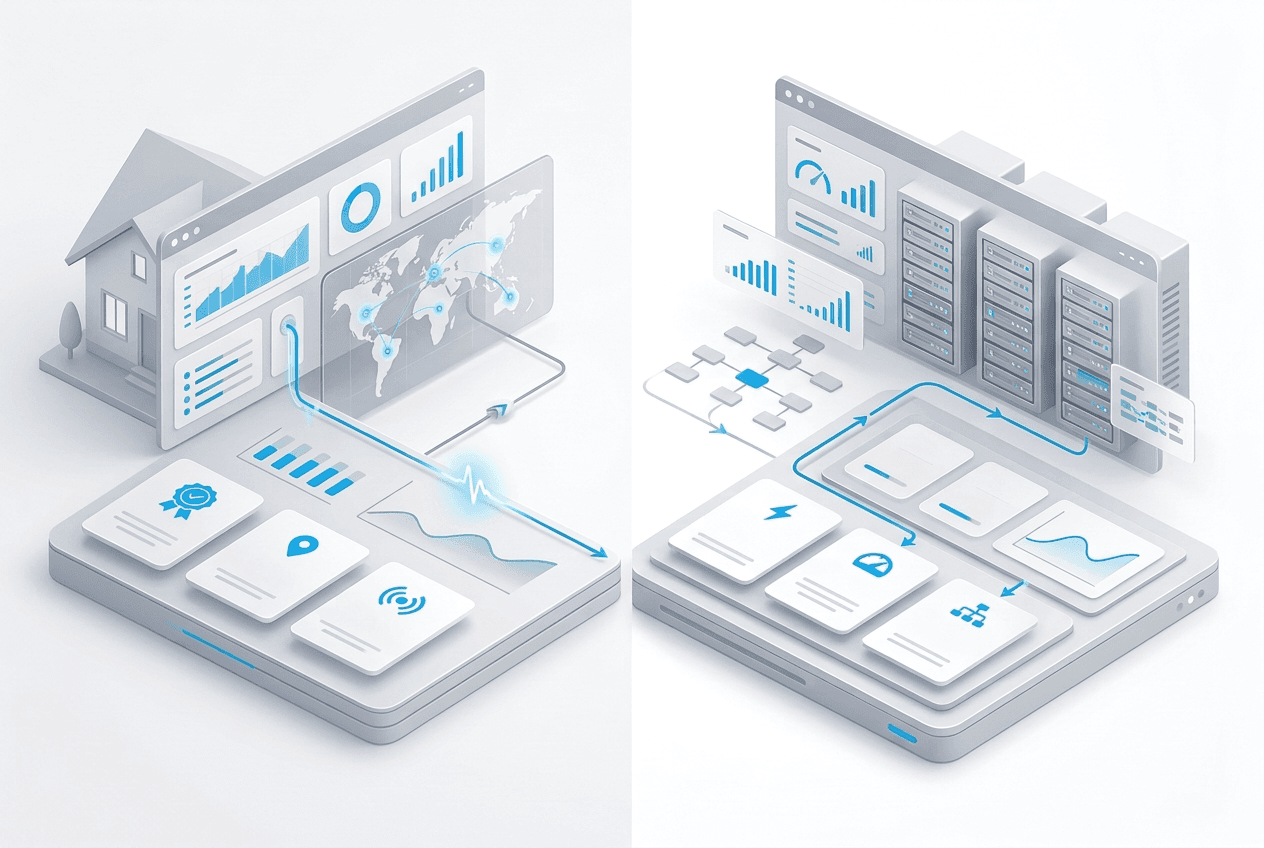
ISP vs residential proxies: what's the difference?
ISP proxies are residential IP addresses hosted on datacenter servers — combining residential trust with datacenter speed. Standard residential proxies route through real user devices, offering larger IP pools but variable performance. Choose ISP for speed-sensitive tasks, residential for maximum pool diversity and anti-bot bypass.
What are ISP proxies?
ISP proxies (also called static residential proxies) use IP addresses assigned by real Internet Service Providers but hosted on data center infrastructure. The IP itself is registered to a residential ASN — so websites see it as a legitimate residential address — but the connection runs through a high-performance server instead of a real household device.
This gives ISP proxies a unique advantage: the trust level of residential IPs combined with the speed and stability of datacenter hosting. Response times are typically under 100ms, connections are stable for hours or days, and there's no risk of the IP going offline because a real user turned off their device.
The trade-off is limited pool size. ISP proxy pools are much smaller than residential pools — typically thousands to low millions versus tens of millions for residential networks. This limits geographic diversity and makes IP rotation less effective for high-volume scraping.
What are residential proxies?
Standard residential proxies route traffic through actual residential devices — smartphones, computers, and home routers connected to consumer ISP networks. When a real user opts into a proxy network, their device's internet connection becomes available to route proxy traffic.
This means residential IPs are genuinely connected to real households with real browsing history and ISP assignments. Anti-bot systems have no reliable way to distinguish proxy traffic from genuine residential browsing.
The pool sizes are massive — TrueProxies offers 50M+ residential IPs across 150+ countries. This diversity means you can rotate through millions of unique IPs, target specific cities or ZIP codes, and distribute requests across an enormous address space.
The trade-off: performance depends on the underlying residential connection. Response times are higher (200–800ms typical), connections can drop if the real user goes offline, and throughput varies based on the household's internet speed.
ISP vs residential proxies — comparison
| Feature | ISP proxies | Residential proxies |
|---|---|---|
| IP source | ISP-assigned, hosted on servers | ISP-assigned, routed through real devices |
| Speed | Very fast (sub-100ms) | Variable (200-800ms) |
| Stability | Very high — always online | Variable — depends on real user |
| Pool size | Small (thousands to low millions) | Large (tens of millions) |
| Detection risk | Low — residential ASN | Very low — genuine residential behavior |
| Session duration | Days to months | Minutes to hours |
| Geo-targeting | Limited locations | Country/City/ZIP/ASN |
| Best for | Long sessions, account management | Scraping, rotation-heavy tasks |
| Cost | Higher per IP | Lower per GB |
When to use ISP proxies
Long-term account management. If you need the same IP for days or weeks — managing social media accounts, maintaining e-commerce seller profiles, or running always-on monitoring — ISP proxies provide the stability residential proxies can't guarantee.
Speed-sensitive operations. Tasks where latency directly impacts results — sneaker copping, ticket purchasing, or real-time bidding — benefit from ISP proxies' datacenter-level response times.
Small-scale, high-value tasks. When you need a handful of trusted, fast, always-available IPs rather than a massive rotating pool. Quality over quantity.
When to use residential proxies
Large-scale web scraping. When you're making thousands or millions of requests and need to rotate across a large, diverse IP pool to avoid detection. Residential proxies' 50M+ pool gives you the diversity ISP proxies can't match.
Geo-targeted data collection. Residential proxies offer granular targeting down to city and ZIP code level across 150+ countries. ISP proxy coverage is typically limited to major markets.
Budget-conscious operations. Per-GB, residential proxies are more cost-effective than ISP proxies. TrueProxies' residential plans start at $1.64/GB, while ISP proxies typically cost $2–5 per IP per month plus usage.
High-volume IP rotation. When you need a fresh IP per request to avoid detection patterns, residential proxies' massive pool ensures you rarely reuse an IP within a session.
What TrueProxies offers
TrueProxies currently offers residential IPv4 proxies (50M+ IPs, 150+ countries) and datacenter IPv6 proxies. Both support sticky and rotating sessions, HTTP/HTTPS/SOCKS5 protocols, and geo-targeting.
For tasks that would typically use ISP proxies — long-term social media management, stable account access — TrueProxies' residential proxies with sticky sessions offer a practical alternative at lower cost. While the sessions won't last as long as dedicated ISP IPs, the combination of sticky sessions and a massive IP pool handles most use cases effectively. Try it free.
Frequently asked questions
Are ISP proxies better than residential proxies?
For speed and session stability, yes. For pool size, geographic diversity, and cost-effectiveness at scale, residential proxies are better. The right choice depends on whether you need a few fast, stable IPs or a large rotating pool.
Can I use residential proxies instead of ISP proxies?
For most tasks, yes. Residential proxies with sticky sessions handle social media management, account access, and monitoring effectively. ISP proxies are only necessary when you need the same IP for days or need sub-100ms response times.
What does ISP proxy mean?
An ISP proxy uses an IP address assigned by a real Internet Service Provider but hosted on datacenter infrastructure. It combines a residential IP's trust score with a datacenter's speed and uptime. Also called static residential proxies.
Which is better for web scraping — ISP or residential?
Residential proxies are better for web scraping due to larger pool sizes and better IP rotation. ISP proxies' smaller pools get exhausted quickly during large-scale crawls. Use ISP proxies only for scraping that requires persistent sessions.