
01
25+ global regions
Datacenter IPv6 plans are distributed across more than 25 global regions, giving teams broad placement options for latency-sensitive testing, regional automation, and multi-market request routing from infrastructure IP space.
IPv6
Last updated:
TrueProxies datacenter IPv6 proxies provide high-speed IPv6 addresses from 25+ regions with unlimited bandwidth and pricing based on proxy count. They are built for teams that want fast, cost-efficient infrastructure IPs for QA, automation, and high-volume tasks that do not require residential trust.
Fresh IPv6 datacenter proxies from 25+ global regions. Built for speed, unlimited transfer, and large request volumes where infrastructure-grade performance matters more than residential reputation.

25+
global regions
Fresh
IPv6 ranges
Unlimited
bandwidth
$77.00
from per month
Pricing
| Proxy count | Monthly price | Notes |
|---|---|---|
1,500 proxies | $77.00 | Published entry plan Start Free Trial |
Larger pools Popular | Contact sales | Daily, weekly, and higher-count options are handled through support Start Free Trial |
| Need more? | Custom capacity | Contact us |
Included
Datacenter IPv6 plans are distributed across more than 25 global regions, giving teams broad placement options for latency-sensitive testing, regional automation, and multi-market request routing from infrastructure IP space.
Clean IPv6 allocations help reduce reputation baggage that can come with recycled address pools. That gives QA and collection workloads a cleaner starting point when residential trust is not required.
Traffic volume is not metered separately, so teams can move large amounts of data without adding a second pricing dimension. That is especially useful for test rigs, repeated checks, and high-request background jobs.
Pricing is based on the number of proxies rather than a speed tier or GB quota. That makes capacity planning easier for teams that think in terms of pool size and concurrent regional coverage.
Datacenter IPv6 is built for speed-first environments where residential trust is less important than throughput, low latency, and operational efficiency. It is a strong fit for QA, internal tooling, and bulk automation.
The product supports both stable assignment and broader pool usage patterns, which lets teams keep deterministic test environments where needed while still distributing traffic across larger proxy sets.
Every major proxy protocol is supported, which keeps automation teams on one simple integration path whether they are working in browsers, test harnesses, API clients, or custom collectors.
High-concurrency workflows are not penalized with a separate connection limit. That matters for smoke tests, high-speed crawlers, and job queues that need to fan out across many proxies at once.
Because the published footprint is region-oriented rather than country-by-country residential coverage, the product is best framed as an infrastructure location tool instead of a hyper-local consumer simulation layer.
Teams that do not need residential trust often prefer datacenter IPv6 because the cost-per-request is easier to optimize and the capacity model is straightforward. It is a pragmatic performance-first option.
Live support remains available through chat and Telegram every day. That is useful when scaling region pools, validating auth, or tuning the pool size required for a given QA or automation environment.
Because pricing is framed around proxy counts, it is easy to move from a smaller test pool into a larger operational pool without changing product type. That keeps growth operationally simple.
Comparison
Datacenter IPv6 is the performance-first option. Residential products trade some raw efficiency for better trust and broader consumer-like coverage, especially when the target is sensitive to infrastructure IPs.
| Feature | Datacenter IPv6 | Residential proxies |
|---|---|---|
| Primary advantage | Speed and cost efficiency | Trust and realism |
| Origin | Datacenter infrastructure | Real ISP / residential traffic |
| Geo model | 25+ regions | 150+ countries or residential footprint |
| Best for | QA, testing, high-speed scraping | Sensitive targets and localization |
| Bandwidth | Unlimited | Unlimited or GB-based |
| Detection profile | Lower trust on strict targets | Higher trust |
| Pricing basis | Proxy count | Speed tier, plan, or GB |
| When to choose | Performance-first workflows | Trust-first workflows |
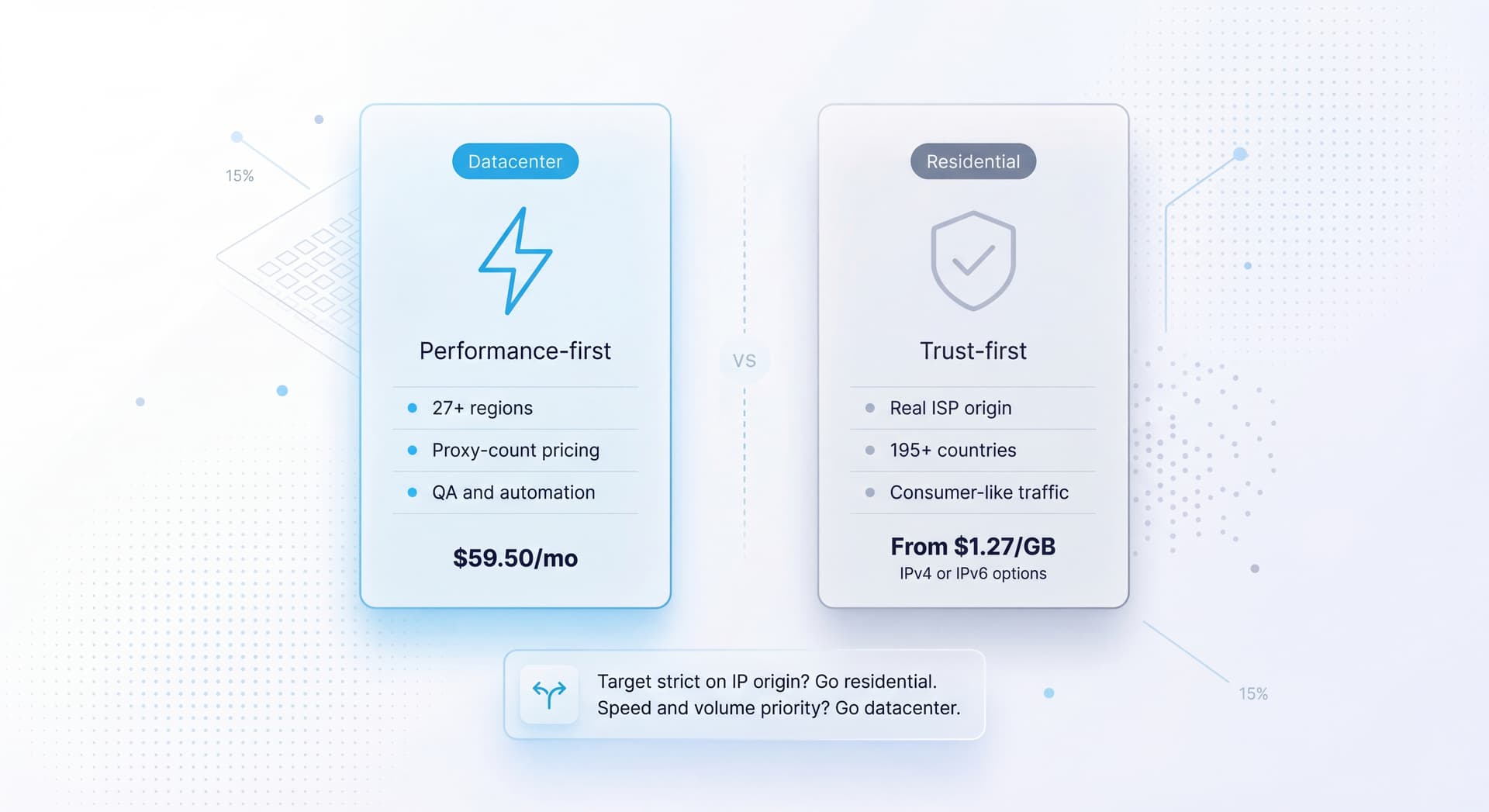
Choose datacenter IPv6 when the workload values speed, pool size, and cost efficiency more than residential trust. Choose residential products when the destination is sensitive to infrastructure-origin traffic.
Setup
Use the entry pool to validate target compatibility, region selection, and expected throughput before committing to a larger proxy count.
Pick the number of proxies that matches your concurrency and regional spread requirements, then configure auth in the dashboard.
Point your tests, automation, or collectors at the standard endpoint and scale proxy count as your throughput requirements increase.
Use cases
Featured workflow
When the target accepts infrastructure IPs, datacenter IPv6 can deliver a lower-cost, speed-first option for broad request volume and fast iteration.
How proxies help with web scraping →Datacenter IPv6 works for performance-first verification and QA workflows where large pool sizes and region coverage matter more than residential trust.
How proxies support ad verification →Large infrastructure pools are useful for repeated checks and monitoring across regions when the target does not require the realism of residential consumer traffic.
How proxies help with brand protection →Integration
Use the same connection pattern as the rest of the lineup, then scale proxy count to match concurrency and region requirements.
Compatible with
curl --proxy http://USER:PASS@connect.trueproxies.com:8080 \
  https://httpbin.org/ip
FAQ
Datacenter IPv6 proxies use infrastructure-hosted IP addresses instead of residential ISP IPs. TrueProxies offers them from 25+ global regions with unlimited bandwidth.
Datacenter proxies are faster and cheaper but easier for websites to detect. Residential proxies appear as real users and pass stricter anti-bot systems.
The TrueProxies datacenter IPv6 starter plan includes 1,500 proxies at $77 per month with unlimited bandwidth and access to 25+ global regions.
Datacenter proxies work well for targets without strict anti-bot defenses. For sites using Cloudflare, DataDome, or similar systems, residential proxies are more reliable.
Yes. TrueProxies datacenter IPv6 plans include region-level targeting across 25+ global locations. Contact support for specific region availability details.
Compare all products
Looking for a different proxy type? Explore other products.
Residential IPv4
Unlimited bandwidth residential IPv4 with fixed speed-tier pricing.
Starts from $3.26
View Unlimited plansResidential IPv4
Same IPv4 network, billed only for the traffic you actually consume.
From $1.64/GB
View GB-Based plansResidential IPv6
Residential IPv6 with real ISP trust and rotation-first delivery.
From $329.99/mo
View IPv6 ResidentialFree trial
Start with a small pool, validate throughput, then scale.
Start Free TrialPublished by TrueProxies · Proxy infrastructure provider since 2026
Datacenter IPv6 — High-Speed
Starting from $77/mo


